Two-way Tables and Conditional Probabilities
Independence 的應用: Sensitive Questions
可以透過隨機化設計,讓受訪者不必直接回答敏感問題。
基本想法: P(Yes)=P(choose A and Yes)+P(choose B and Yes)
若「選到哪題」與敏感行為 independent,則: P(choose B and Yes)=P(choose B)P(Yes to B)
因此可由整體 Yes 比例反推出敏感行為比例。
Genetics
基本名詞
| 名詞 |
意義 |
| Gene |
基因 |
| Allele |
等位基因 |
| Genotype |
基因型 |
| Phenotype |
表現型 |
| Homozygous |
同型合子 |
| Heterozygous |
異型合子 |
| Dominant |
顯性 |
| Recessive |
隱性 |
通常:
- 大寫: dominant allele
- 小寫: recessive allele
Probability Computation Rules
Addition Rule
若 A、B mutually exclusive: A∩B=∅
則: P(A∪B)=P(A)+P(B)
只有互斥事件才能直接把機率相加
Multiplication Rule
兩事件: P(A1∩A2)=P(A1)P(A2∣A1)
三事件: P(A1∩A2∩A3)=P(A1)P(A2∣A1)P(A3∣A1∩A2)
一般化: P(A1∩⋯∩Ak)=P(A1)P(A2∣A1)⋯P(Ak∣A1∩⋯∩Ak−1)
Diagnostic Test
設:
- A = true positive status
- Ac = true negative status
- B = test positive
- Bc = test negative
|
True + |
True - |
| Test + |
True Positive |
False Positive |
| Test - |
False Negative |
True Negative |
False Positive Rate
- 沒有疾病,卻驗成 positive
- α=P(B∣Ac)
False Negative Rate
- 真的有疾病,卻驗成 negative
- β=P(Bc∣A)
Sensitivity
- 有病的人中,成功驗出 positive 的機率:
- Sensitivity=P(B∣A)=1−β
Specificity
- 沒有病的人中,成功驗出 negative 的機率
- Specificity=P(Bc∣Ac)=1−α
Risk Evaluation
Relative Risk (RR)
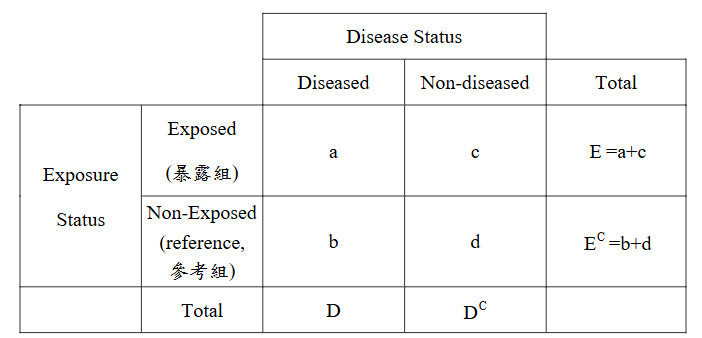
Relative Risk 比較 exposed 與 non-exposed 的 disease risk:
RR=P(D∣Ec)P(D∣E)
RR=b/(b+d)a/(a+c)
判讀:
- RR>1: exposure 增加 risk
- RR=1: risk 相同
- RR<1: exposed group risk 較低
Odds & Odds Ratio (OR)
Odds(D)=P(Dc)P(D)
- Exposed group: OddsE=ca
- Non-exposed group: OddsEc=db
OR=b/da/c=bcad
判讀:
- OR=1: no association
- OR>1: positive association
- OR<1: negative association
RR vs. OR
|
RR |
OR |
| 比較 |
Risk |
Odds |
| 公式 |
P(D∣E)/P(D∣Ec) |
ad/bc |
| Reference value |
1 |
1 |
| Case-control |
不可直接估 |
可估 |
Different Sampling Schemes
-
Fix Total
- 只固定整體 sample size
- Multinomial sampling
-
Fix Row Totals
- 固定 exposed 與 non-exposed 人數
- Binomial sampling
-
Fix Column Totals
case-control study- 固定: Diseased total/Healthy total
RR 不可直接估- OR 可估
case-control study 先固定 disease status,所以: a+ca 和 b+db 不再代表母體中的真正 disease risk。適合 rare disease、節省時間/成本
Bayes Theorem
Partition
若: A1,A2,…,Ak partition sample space,需滿足:
- Ai∩Aj=∅(i=j)
- A1∪A2∪⋯∪Ak=S
Total Probability
P(B)=∑kP(B∣Ak)P(Ak)
P(Aj∣B)=P(B)P(B∣Aj)P(Aj)
代入 total probability:
P(Aj∣B)=∑kP(B∣Ak)P(Ak)P(B∣Aj)P(Aj)
Diagnostic Test + Bayes
實驗室通常給 sensitivity: P(test +∣disease)
但受測者真正想知道的是: P(disease∣test +)
使用 Bayes theorem:
P(A∣B)=P(B)P(B∣A)P(A)
而: P(B)=P(B∣A)P(A)+P(B∣Ac)P(Ac)
所以: P(A∣B)=P(B∣A)P(A)+P(B∣Ac)P(Ac)P(B∣A)P(A)


